Johannes Kepler, best known for his laws of planetary motion, did not see a boundary between the mathematical rigour of astronomy and the symbolic interpretation of the heavens. To Kepler, the cosmos was a harmonious structure built upon the foundations of geometry and musical theory.
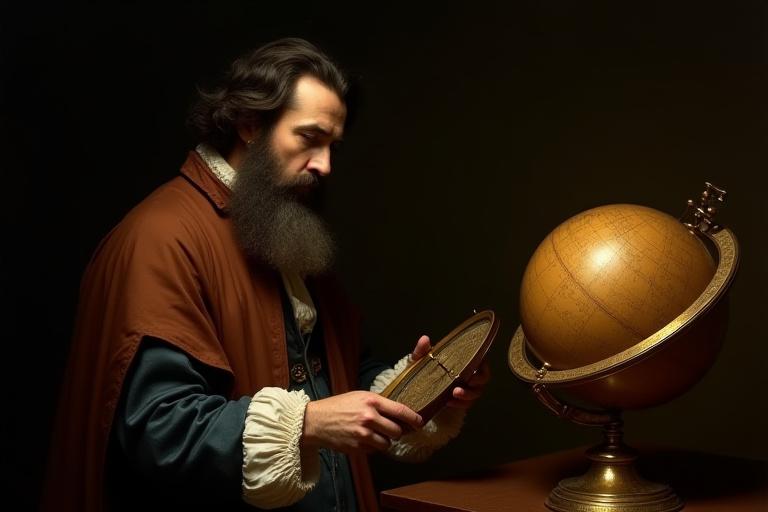
Johannes Kepler (1571–1630): A mind bridging two worlds.
Harmonics in Music and Geometry
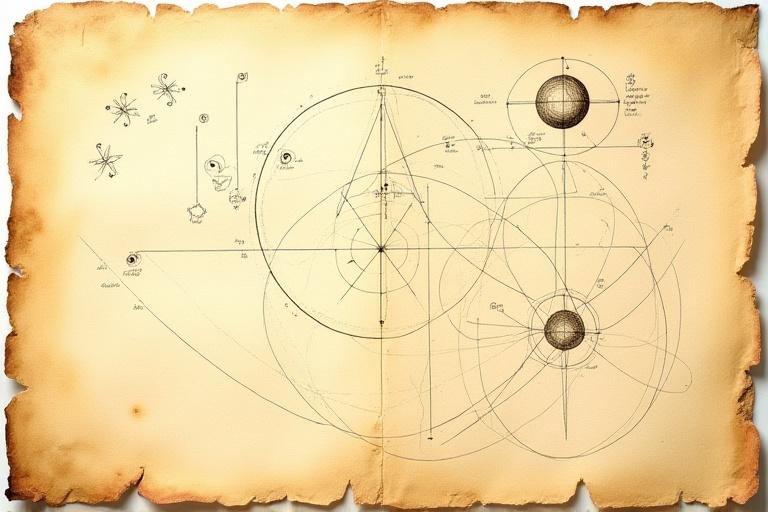
Kepler's magnum opus, Harmonices Mundi (The Harmony of the World), explored the idea that the soul is attuned to the mathematical proportions found in both music and the movements of celestial bodies. He believed that the "aspects"—the angles between planets—were meaningful only when they corresponded to "knowable" polygons that could be constructed using a compass and straightedge.
The Constructible Aspect
Kepler insisted that for a relationship between planets to be valid, it must relate to a regular polygon that is mathematically constructible. This led him to redefine the traditional list of aspects through the lens of pure geometry.
Defining the Minor Aspects
While traditional practitioners used five major aspects (Conjunction, Sextile, Square, Trine, and Opposition), Kepler introduced others based on his harmonic theories. He notably introduced the Quincunx (150°), the Bi-quintile (144°), and the Sesquiquadrate (135°).
-
The Quintile (72°)
Based on the pentagon. Kepler viewed this as a signature of mental clarity and high-functioning talent.
-
The Sesquiquadrate (135°)
A division of the circle into eight, representing friction that leads to necessary mathematical correction.
Separating Geometry from Superstition
For Kepler, the purpose of this study was to remove what he called the "fecal matter" of superstition from the gold of celestial observation. He sought an objective, structural reason why the planets influenced the human spirit, concluding that it was not through mystical forces, but through the resonance of mathematical truth acting upon the human soul—a soul he believed was inherently geometric in its reasoning.
Interested in the vocabularly of the stars?
Explore our Glossary