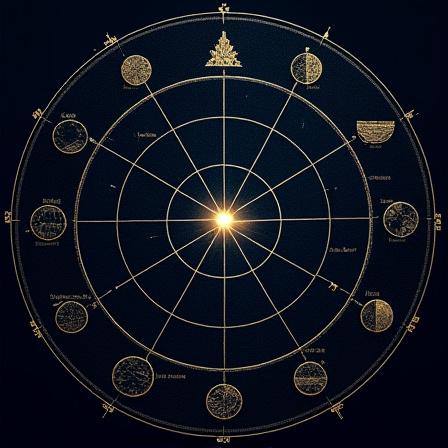
Historical Context: The House of Isolation
In traditional Hellenistic and Medieval astrology, the 12th House was often regarded with a sense of trepidation. Termed the Kakodaimon (Bad Spirit), it was historically associated with "hidden enemies," self-undoing, and places of confinement such as prisons or hospitals. This objective view reflected a society where social standing and visible relationships were paramount; anything hidden was inherently suspicious.
Historically, this sector of the sky represented the period just before sunrise—a time of mist and obscured visibility. It symbolized the forces outside of one's control, the vast unknown that could either swallow the individual or offer a sanctuary from the world's demands.
The Psychological Shift: Jung and the Collective
With the advent of modern psychological astrology, particularly influenced by Carl Jung, the 12th House underwent a profound revaluation. It transitioned from a literal prison to a metaphorical one: the subconscious mind. Jungian concepts like the Collective Unconscious found a natural home here.

Instead of external "hidden enemies," modern practitioners interpret this house as the repository of suppressed traits, family secrets, and ancestral patterns. It is the womb and the grave—the space where the ego dissolves into the larger sea of human experience.
Literary Archetypes of the 12th House
The themes of the 12th House resonate deeply in classic literature. We see its influence in the tragic isolation of characters like Oedipus, whose "enemies" were hidden within his own lineage, or in the monastic silence of The Name of the Rose. It is the "Dark Night of the Soul" described by St. John of the Cross—a necessary period of withdrawal that precedes spiritual rebirth.
- The Hermit: The archetypal figure who finds wisdom in solitude.
- The Martyr: Symbolizing the 12th house theme of sacrifice and ego-dissolution.
- The Ghost: Representing the lingering influence of the past that remains unseen but felt.
Divorcing Fear from the Symbol
At zerodrome, we aim to provide an objective lens on these historical symbols. To understand the 12th House is to recognize that human experience requires a private space for integration. By removing the fatalistic language of the past, we can appreciate the 12th house as a cultural construct used to describe the universal human need for introspection, rest, and the processing of things that lie beneath the surface of everyday life.